The 287(g) Program

Mapping the active partnerships between
Immigration and Customs Enforcement (ICE) and
local + state law enforcement agencies across the U.S.

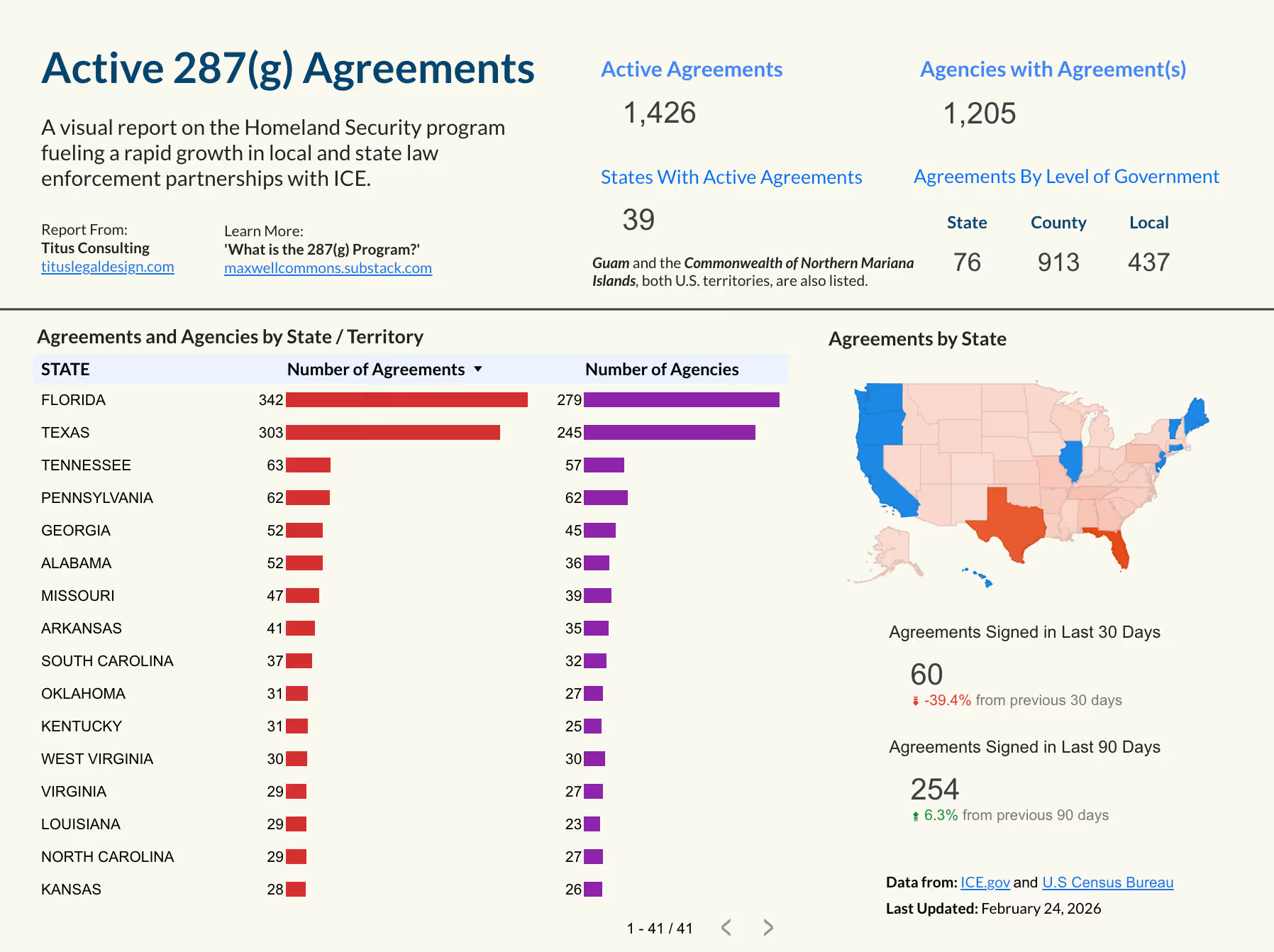
Screenshot of home page from "Active 287(g) Agreements" report published by Titus Consulting via Looker Studio (Google):
https://lookerstudio.google.com/reporting/ebe8be08-53be-4afc-9240-83ec3075e873

Interactive Report

For full-screen + mobile-friendly access/navigation, visit the full original report hosted on  Google Data Studio

Canceled Agreements

Includes agreements removed from ICE's published list after December 8th, 2025.

County-Level Agreement Map

Filled-area map of U.S. counties with at least one active county-level 287(g) agreement.

About the Report

How to use the interactive report + the data behind it.

The Data

Where does the data come from?
The original ('raw') agreement data comes directly from ICE, which publishes an Excel spreadsheet of active 287(g) agreements on its website.

ICE uses a snapshot approach to publish this data: when an updated spreadsheet is added to the site, it replaces the previous version entirely. This means each version of the spreadsheet only reflects the currently active agreements at the time of publishing. This approach effectively overwrites the previous snapshot with each published update. There is no changelog, no historical archive, and no unique identifiers for individual agreements.

What this means: The above report reflects a processed, or 'cleaned', version of ICE's raw spreadsheet data — edits are made to fix discrepancies in agency and jurisdiction names, errant whitespaces, typographical errors and other verifiable data entry issues.

For example: an incorrect 'Signed Date', for an agreement with the Ottawa County Sheriff's Office in Oklahoma. While ICE's published list continues to list an agreement, signed by the Ottawa County Sheriff's Office in Oklahoma, with a signature date of February 23, 2025. But the agreement was actually signed on February 23,as confirmed in the corresponding Memorandum of Agreement published by ICE).

Other Data Sources:
- 'Location' Field: For each active agreement, we add a 'location' using publicly-sourced address data — from the corresponding agency's official website whenever possible — in the format '[City] [State Abbreviation] [ZIP Code]' to align with geographic mapping syntax in Google Data Studio.  

- Population Estimates: For each active agreement, an estimated 'Population' is populated from the U.S. Census Bureau's American Community Survey (ACS) data for 2024.

Digging Into ICE's Messy 287(g) Data w/ Andrew Thrasher by Austin Kocher

I sat down with Andrew Thrasher to talk about why ICE's 287(g) data is so hard to work with, what he's built to make it usable, and why getting this right matters for accountability.

Read on Substack

Counting to 1,414 Is Harder Than It Seems by Andrew Thrasher

Or: 'Todd and the Terrible, Horrible, No Good, Very Bad ICE Data'

Read on Substack
How does the report work?
We use Google Data Studio (formerly known as Looker Studio) to host the report. Our processed and enriched dataset is fed directly into Data Studio, which helps ensure accurate, consistent, and timely data across each chart and map in the report. You can learn more about Data Studio via this user guide, or through this short training, which is part of a longer course from Google on 'data journalism').

Note on Google: While our report is currently hosted on Data Studio, Google has shown a growing affinity for cooperating with the federal government's weaponized surveillance and illegal overreach campaign, which continues to target members of the media, advocacy groups and demonstrators, politicians, and vulnerable communities across the U.S. (and across the globe). With that said, we use Google reluctantly — and with an eye toward hosting this report on a tool more aligned with our expectations for reliable, trustworthy product vendors.

The Policy + Law

What is the 287(g) program?
Section 287(g) of the Immigration and Nationality Act authorizes Immigration and Customs Enforcement (ICE) to enter into agreements with state and local law enforcement agencies in order to delegate certain immigration enforcement functions to officers in these partner agencies across the country.

These agreements effectively deputize local officers to act on behalf of the federal government (i.e., ICE), with varying degrees of authority depending on the program model. Agreements can be signed at three levels of government:

- County agencies (like sheriffs' and district attorneys' offices)
- Municipal agencies (like local police departments and university campus police)
- State agencies (like state police/highway patrols and prisons)

The program has expanded rapidly since January 2025, growing from 134 active agreements to more than 1,770 active in late April 2026.
What are the different types of the 287(g) agreement?
There are three (3) operational models, with varying degrees of collaboration and scope of authority/jurisdiction for participating agencies and officers:

The Jail Enforcement Model (JEM) model — a designated officer in a local or state jail screens individuals arrested and booked on other charges against federal immigration databases.

The Warrant Service Officer (WSO) model — officers are authorized to execute existing administrative warrants issued by ICE.

The Task Force (TFM) model — the most expansive version, in which participating officers are effectively deputized to enforce federal immigration law in the course of their normal police work. Task Force officers can question and arrest individuals for suspected violations of civil immigration law during routine law enforcement activity, after a short online training from ICE.

The Task Force Model was previously halted in 2012 due to racial profiling concerns, but was reactivated shortly after the January 2025 presidential inauguration, and has seen rapid adoption (particularly among municipal agencies) since. As of April 30, 2026, there are 1,091 Task Force Model agreements — representing a large majority (61.6%) of total active agreements.

Learn More:
- '287(g) Agreements With ICE Threaten Welcoming Communities', American Immigration Council (September 2025)

- 'Deputized for Disaster', ACLU (February 2026)

- 'Immigration Dragnet: The New Era of 287(g)', Immigrant Legal Resource Center (July 2025)

Frequent Questions

What is the difference between # of agreements and # of agencies?
A  law enforcement agency can have up to three (3) agreements active at the same time, across the three program models. When this report shows the total number of agreements, that number will be higher than the number of unique participating agencies.

For example: the 1,770 active agreements on April 30, 2026 correspond to 1,493 unique agencies.

Both figures are meaningful. The total number of active agreements is helpful to understand the full scope of delegated immigration enforcement authority involved, while the number of agencies tells us the number of distinct law enforcement agencies (or 'LEAs')  involved in the program.
What are the (known) limitations of the data?
ICE’s 287(g) active agreement data is a released as a snapshot — when agreements are added or removed, the updates are published as a completely new version of the Excel spreadsheet, available for download on the program landing page. This means each version of the spreadsheet lists the agreements active on the date it was published. There is no historical archive, so the ability to track changes requires reconstructing this metadata from saved snapshots.

We use a composite key (state + agency name + agreement type + signature date) to track agreements, but this is admittedly fragile. For example: when ICE corrects a typo in the agency name, there is no record of those changes on the published list, and our composite key is 'broken'.

Tracking for canceled agreements is only available for those removed from ICE's published list since December 8, 2025, as it requires intentional tracking to identify deleted rows from previous versions of the official list.

Some municipality population values may show as "NOT FOUND", where Census ACS data can't be reliably matched, or the jurisdiction covered by the agreement is not clear. This is the case for almost all of the Constable Officers participating (primarily in Pennsylvania, Tennessee, and Texas), which typically cover a segment of the larger county (and, therefore, listed by ICE as municipal-level agreements).

Historically, ICE has also over-counted the number of agreements by including the header row in their sum totals, and other typographical and data entry errors are common.
287(g) Scenario Simulator

Learn More